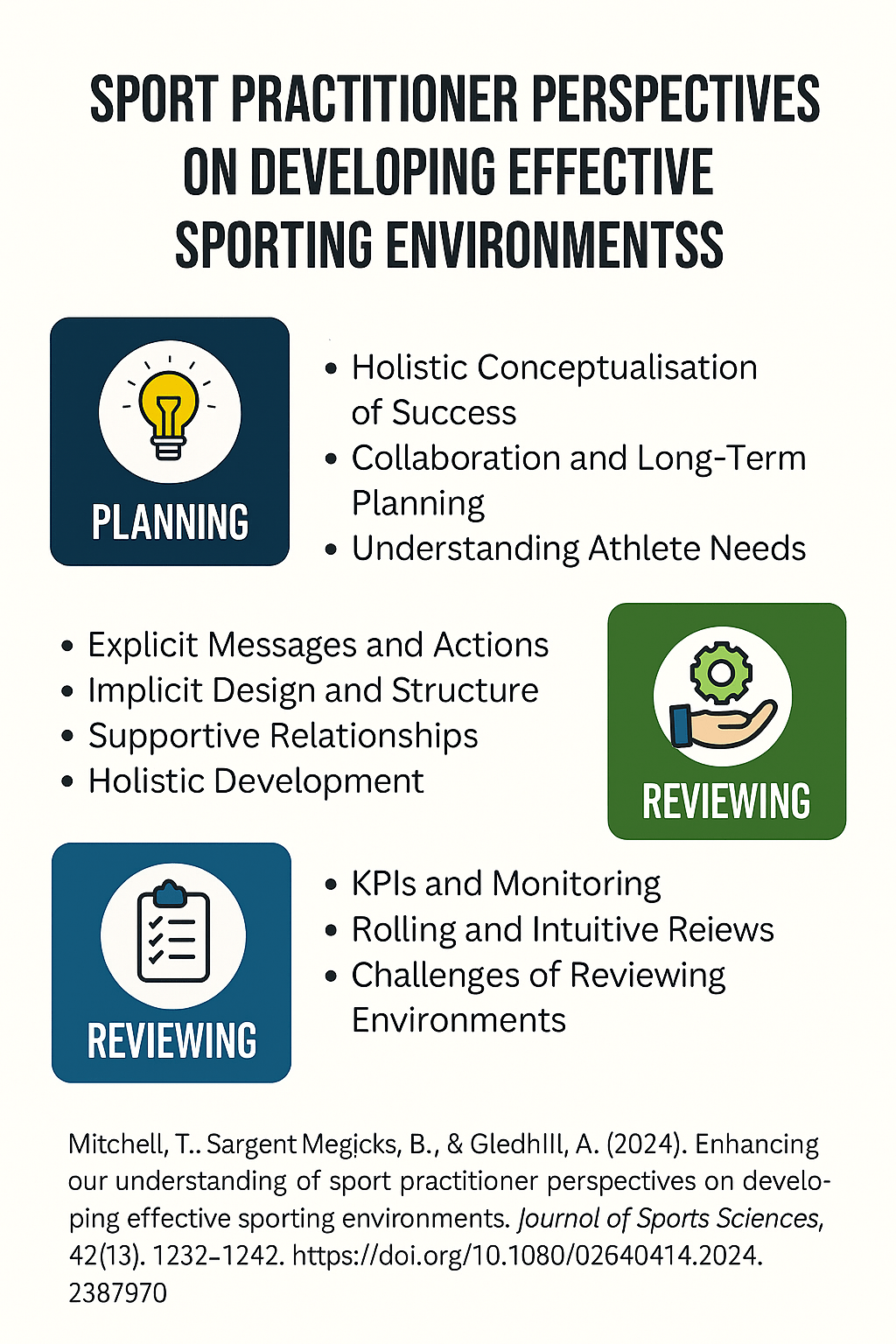
This post is based on one of my papers in the journal of sport sciences – Mitchell, T., Sargent Megicks, B., & Gledhill, A. (2024). Enhancing our understanding of sport practitioner perspectives on developing effective sporting environments. Journal of Sports Sciences, 42(13), 1232–1242. https://doi.org/10.1080/02640414.2024.2387970
Over the last twenty years, research has shown convincingly that the environments athletes train and develop in matter—a lot. We know that high quality talent development environments (TDEs) offer long-term support, coherent messages, holistic preparation, and opportunities for athletes to develop as people as well as performers (Martindale et al., 2005; Henriksen et al., 2010a). Yet despite this growing body of knowledge, one important voice has been relatively quiet: the sport practitioners who design, deliver, and review these environments every day.
That gap is exactly what motivated me to conduct this study. With so much focus placed on athlete perceptions (e.g., Li et al., 2015; Martindale et al., 2010), I wanted to understand what practitioners think about their environments—how intentional they are, which strategies they use, and how they evaluate their work. Our interviews with ten coaches, programme managers, psychologists, and support staff offered a rare and in-depth look at these perspectives, and the findings have important implications for how we design future TDEs.

Why Environments Matter
Sport environments shape behaviours, relationships, motivations, and learning opportunities. They can support wellbeing (Kuettel & Larsen, 2020), facilitate transitions (Hauser et al., 2022), and provide the foundations for future performance. They can also hinder development if poorly aligned or inconsistently delivered.
Much of the existing work in this space has examined athletes’ perceptions using tools like the Talent Development Environment Questionnaire (TDEQ; Martindale et al., 2010) or the TDEQ5 (Li et al., 2015). These studies consistently highlight both strengths and weaknesses in TDEs—for example, athletes often report holistic preparation as the weakest component (Curran et al., 2021; Mitchell et al., 2021). Research using immersive frameworks such as the Athlete Talent Development Environment (ATDE) model has also demonstrated the importance of organisational culture, coherent aims, and integrated support systems (Henriksen et al., 2010a, 2010b; Larsen et al., 2013).
But these approaches rarely tell us how practitioners themselves conceptualise, design, or refine their environments. That’s where our study comes in.

What Practitioners Told Us About Planning, Doing, and Reviewing
Our findings aligned with a planning–doing–reviewing (PDR) framework (Abraham et al., 2014), revealing how practitioners think about environmental design.

1. Planning: Clear Intentions and Long Term Thinking
Across roles and sports, practitioners emphasised the need for clear objectives when creating their environments. This reflects earlier research showing the importance of shared mental models among staff members (CannonBowers et al., 1993) and the value of coherent organisational planning (Taylor & Collins, 2021).
Practitioners described taking a holistic view of success, acknowledging that only some athletes would reach elite levels—but all deserved meaningful, positive experiences. This perspective mirrors longstanding arguments for holistic athlete support (Martindale et al., 2005; Bergeron et al., 2015).
They also highlighted the need to align their plans with organisational expectations—sometimes navigating tensions between long-term development and short-term performance demands. This challenge is well established in the literature (Martindale et al., 2007; Li et al., 2015).
Importantly, planning wasn’t done in isolation. Many spoke about multidisciplinary team (MDT) meetings, which allowed support staff, coaches, and analysts to pool their perspectives. Research has long suggested that MDT alignment enhances clarity and quality of support (Till et al., 2019), and our findings reinforce this.
Finally, practitioners stressed the importance of understanding athlete needs, using profiling, feedback, and benchmarking to individualise development. Such approaches echo broader calls for personalised pathways in TDEs (Henriksen et al., 2010b; Larsen et al., 2013).

2. Delivering: Blending Explicit and Implicit Strategies
When we explored how practitioners actually shape environments on the ground, they described a rich mix of explicit and implicit strategies.
Explicit strategies
Practitioners used clear messaging, induction events, and educational workshops to communicate values and expectations. Such planned interventions parallel evidence on promoting psychosocial development (Petitpas et al., 2005) and the value of repeated cultural reinforcement in high-performance settings.
Implicit strategies
More subtly, practitioners described designing experiences that would shape behaviour without always being directly explained. Examples included:
- creating psychologically safe spaces,
- allowing for mistake making,
- planning challenges (e.g., repeatedly placing teams in losing scenarios), and
- exposing athletes to pressure or adversity.
These strategies align with experiential learning approaches (Jones & Lavallee, 2009), challenge based development (Collins & MacNamara, 2012; Taylor et al., 2022a), and implicit life skill transfer mechanisms (Turnnidge et al., 2014).
Support and relationships
One of the most consistent themes was the importance of the coach–athlete relationship. This mirrors a large body of evidence showing its influence on motivation, wellbeing, and performance (Jowett, 2017; Ivarsson et al., 2015). Practitioners also emphasised the value of supporting families and schools—reinforcing the ATDE model’s emphasis on athletes’ wider ecology (Henriksen et al., 2010a).
Holistic development
Practitioners viewed psychosocial development as inseparable from performance. They spoke about fostering autonomy, growth mindset, and self regulation—elements supported in frameworks like the Psychological Characteristics of Developing Excellence (MacNamara et al., 2010a, 2010b). Tours, group reflections, and problem-solving sessions all acted as vehicles for broader life skill development (Weiss et al., 2013; Pierce et al., 2017).

3. Reviewing: The Most Underdeveloped Stage
Interestingly, reviewing emerged as the least formalised part of the PDR cycle. Practitioners acknowledged the challenges of evaluating environments, particularly intangible elements like culture or self organisation.
Some used performance indicators, especially in measurable sports like swimming. Others relied on rolling reviews, daily reflections, or intuitive “gut feelings.” While these approaches provide valuable insights, the lack of structured review systems echoes wider concerns raised in the literature (Hall et al., 2019; Mitchell et al., 2024). As environments are complex and dynamic (Mitchell et al., 2021), developing more robust review mechanisms should be a key priority going forward.

What This Means for Practice
Based on our findings—and the broader research base—I believe that future work in coaching and talent development should:
- Prioritise intentional planning with shared objectives and organisational alignment.
- Blend explicit teaching with experiential learning, using challenge strategically.
- Enhance review systems that capture environmental impact, not just athlete performance.
- Champion holistic development, recognising its central role in longterm success.
Effective environments don’t emerge by chance—they are carefully designed, purposefully delivered, and thoughtfully refined. By better understanding practitioner perspectives, we can continue improving the environments that shape athletes’ lives both within and beyond sport.

References (APA 7th Edition)
Abraham, A., Saiz, S., Mckeown, S., Morgan, G., Muir, B., North, J., & Till, K. (2014). Planning your coaching: A focus on youth participant development. In C. Nash (Ed.), Practical sports coaching (pp. 16–53). Routledge.
Bergeron, M. F., Mountjoy, M., Armstrong, N., Chia, M., Côté, J., Emery, C. A., … Engebretsen, L. (2015). International Olympic Committee consensus statement on youth athletic development. British Journal of Sports Medicine, 49(13), 843–851.
Cannon-Bowers, J. A., Salas, E., & Converse, S. (1993). Shared mental models in expert team decision making. In N. J. Castellan Jr (Ed.), Individual and group decision making (pp. 221–246). Erlbaum.
Collins, D., & MacNamara, Á. (2012). The rocky road to the top: Why talent needs trauma. Sports Medicine, 42(11), 907–914.
Curran, O., MacNamara, A., & Passmore, D. (2021). Examining coherence in a talent development pathway. Journal of Sports Sciences, 39(15), 1709–1716.
Hauser, L.-L., Harwood, C. G., Höner, O., O’Connor, D., & Wachsmuth, S. (2022). Talent development environments within sports: A scoping review. International Review of Sport & Exercise Psychology.
Hall, A. J. A., Jones, L., & Martindale, R. J. J. (2019). The TDEQ as a tool to drive excellence in elite sport environments. International Sport Coaching Journal, 6(2), 187–198.
Henriksen, K., Stambulova, N., & Roessler, K. K. (2010a). Holistic approach to athletic talent development environments. Psychology of Sport & Exercise, 11(3), 212–222.
Henriksen, K., Stambulova, N., & Roessler, K. K. (2010b). Successful talent development in track and field. Scandinavian Journal of Medicine & Science in Sports, 20(s2), 122–132.
Ivarsson, A., Stenling, A., Fallby, J., Johnson, U., Borg, E., & Johansson, G. (2015). Predictive ability of the TDE on wellbeing. Psychology of Sport & Exercise, 16, 15–23.
Jones, M., & Lavallee, D. (2009). Perceived life skills development and sport participation. Qualitative Research in Sport and Exercise, 1(1), 36–50.
Jowett, S. (2017). Coaching effectiveness: The coach–athlete relationship. Current Opinion in Psychology, 16, 154–158.
Kuettel, A., & Larsen, C. H. (2020). Risk and protective factors for mental health in elite athletes. International Review of Sport & Exercise Psychology.
Larsen, C. H., Alfermann, D., Henriksen, K., & Christensen, M. K. (2013). Successful talent development in soccer. Sport, Exercise, & Performance Psychology, 2(3), 190–206.
Li, C., Wang, C. K. J., Pyun, D. Y., & Martindale, R. (2015). Development of the TDEQ-5. Journal of Sports Sciences, 33(17), 1831–1843.
MacNamara, Á., Button, A., & Collins, D. (2010a). Psychological characteristics for developing excellence (Part 1). The Sport Psychologist, 24(1), 52–73.
MacNamara, A., Button, A., & Collins, D. (2010b). Psychological characteristics for developing excellence (Part 2). The Sport Psychologist, 24(1), 74–96.
Martindale, R. J., Collins, D., & Daubney, J. (2005). Talent development: A guide for practice and research. Quest, 57(4), 353–375.
Martindale, R. J., Collins, D., & Abraham, A. (2007). Effective talent development: Elite coach perspectives. Journal of Applied Sport Psychology, 19(2), 187–206.
Martindale, R. J. J., Collins, D., Douglas, C., & Whike, A. (2012). Ecological validity of the TDEQ. Journal of Sports Sciences, 31(1), 41–47.
Martindale, R. J. J., Collins, D., Wang, J. C. K., … Westbury, T. (2010). Development of the TDEQ. Journal of Sports Sciences, 28(11), 1209–1221.
Mitchell, T. O., Gledhill, A., Shand, R., … Till, K. (2021). Players’ perceptions of TDEs in English football. International Sport Coaching Journal, 8(3), 362–370.
Mitchell, T. O., Cowburn, I. H. J., Alder, D. B., … Piggott, D. (2024). Integrating psychosocial skill development in academy soccer. International Sport Coaching Journal.
Petitpas, A. J., Cornelius, A. E., Van Raalte, J. L., & Jones, T. (2005). Framework for planning youth sport programmes. The Sport Psychologist, 19(1), 63–80.
Pierce, S., Gould, D., & Camiré, M. (2017). Life skills transfer. International Review of Sport & Exercise Psychology, 10(1), 186–211.
Taylor, J., Ashford, M., & Collins, D. (2022a). The role of challenge in talent development. Psych, 4(4), 668–694.
Taylor, J., Ashford, M., & Collins, D. (2022b). Tough love in coaching. Sports, 10(6), 83.
Taylor, J., & Collins, D. (2021). Barriers to optimising talent development experience. Journal of Expertise, 4(3), 315–332.
Till, K., Muir, B., Abraham, A., Piggott, D., & Tee, J. (2019). Decisionmaking frameworks in S&C coaching. Strength & Conditioning Journal, 41(1), 14–26.
Turnnidge, J., Côté, J., & Hancock, D. J. (2014). Positive youth development from sport to life. Quest, 66(2), 203–217.
Weiss, M. R., Stuntz, C. P., Bhalla, J. A., … Price, M. S. (2013). Life skills in youth sport: First Tee findings. Qualitative Research in Sport, Exercise & Health, 5(2), 214–244.
 info@ehponline.co.uk
Leave a comment