
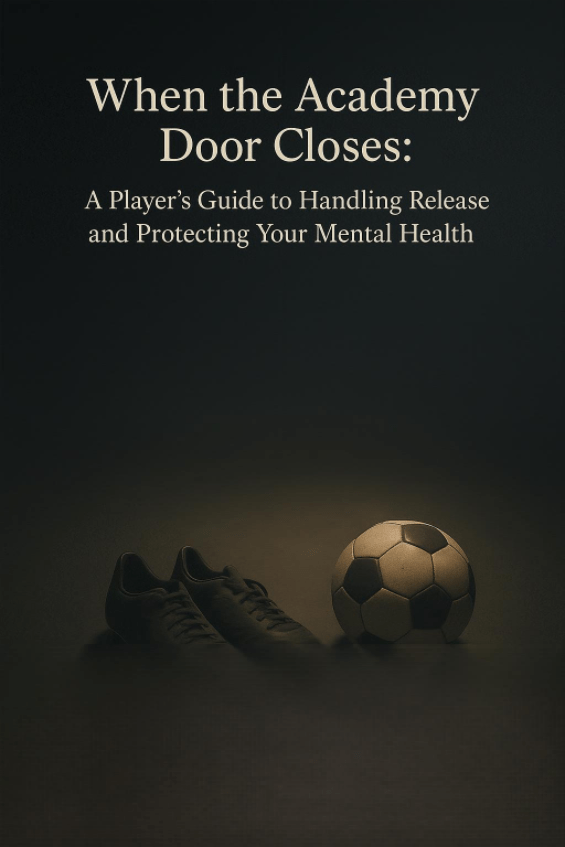
Being released can feel like the ground has vanished under your boots—routine gone, status gone, teammates scattered. Qualitative research with former academy scholars describes the release meeting as “traumatic,” with psychological difficulties often persisting when aftercare is limited. (McGlinchey et al., 2022). For many, the pain is bound up with athletic identity—when “footballer” becomes your entire sense of self—so the decision feels like a personal loss rather than a sporting outcome. (Brewer et al., 1993; Brewer & Petitpas, 2017).
This guide is for you—the player—to help you understand what’s happening psychologically, use evidence‑based tools to steady yourself, and see how working with a sport psychologist can accelerate your reset.
Why it hurts: Identity, expectations, and the “first death”
Players often describe release as going “from everything to nothing in a split second,” capturing the sudden loss of structure, belonging, and future certainty. (McGlinchey et al., 2022). Commentators have highlighted the scale of the issue and called for mandated psychological aftercare for released academy players. (BPS, 2025; NationalWorld, 2025).
What you’re feeling is normal (even if it’s heavy)
Common reactions mirror grief: shock, anger, shame, anxiety, and periods of low mood. Qualitative accounts show some players avoid support and struggle more long‑term; limited club follow‑up can compound this. (McGlinchey et al., 2022). Across sport, transitions are now viewed through a holistic lifespan lens—athletic, psychological, social, and educational layers interact—so it’s expected that a change in one layer (football) hits other parts of life. (Wylleman et al., 2004; Stambulova et al., 2021).
First steps
- Name the losses—routine, teammates, status—and expect feelings to come in waves. (McGlinchey et al., 2022).
- Book a professional check‑in early; aftercare is recommended by national bodies for a reason. (BPS, 2025; NationalWorld, 2025).
Your support network is a performance tool—use it
Social support consistently protects mental health in athletes: meta‑analysis shows it correlates with higher well‑being and lower anxiety, depression, and stress, with family/friends’ support especially impactful. (Luo et al., 2025). Studies in sport injury contexts (a comparable high‑stress event) show esteem and emotional support buffer harmful psychological responses such as isolation. (Mitchell et al., 2014).
What to ask for
- Emotional support (“Listen—don’t fix yet”). (Mitchell et al., 2014). [pure.cardi…fmet.ac.uk]
- Esteem support (“Remind me what I do well beyond football”). (Mitchell et al., 2014). [pure.cardi…fmet.ac.uk]
- Practical support (help with a CV, training partner, travel to trials). (Luo et al., 2025).
A sport psychologist can also help map your current support, coach you to ask for the right help at the right time, and involve parents/partners constructively so you’re not carrying this alone. (Wylleman et al., 2004; Stambulova et al., 2021).
Train your mind like you train your body: two evidence‑based skills
1) Self‑compassion (firm, not fluffy)
Athletes who shift from harsh self‑criticism to self‑compassion report better coping, steadier confidence, and healthier motivation under pressure. (Frentz et al., 2020; Mosewich et al., 2019). Reviews and chapters in applied sport psychology show self‑compassion is a practical, learnable mental skill that supports both performance and well‑being. (Mosewich et al., 2023).
3‑minute drill
- Notice: “This hurts.” 2) Normalize: “Other players go through this.” 3) Coach: “What’s my next right action today?” (Frentz et al., 2020; Mosewich et al., 2019).
2) Mindfulness (short, consistent, sport‑specific)
Research show mindfulness‑based programs reduce competitive anxiety and improve mental health markers; effects are often stronger after ~7 weeks. (Wang et al., 2024; Myall et al., 2023; Ge Yu et al., 2024). Even smartphone‑delivered programs are feasible (though results vary), indicating you can practice anywhere. (Gao et al., 2024).
10‑minute routine (5 days/week, 7 weeks)
- 3′ Box breathing (4‑4‑4‑4)
- 4′ Body scan (notice, don’t fix)
- 3′ Breath counts (to 10; restart when distracted)
(Wang et al., 2024; Myall et al., 2023).
A sport psychologist can tailor these to your position demands (e.g., attentional resets for defenders vs. strikers) and embed them into pre‑trial routines. (Myall et al., 2023).
Rebalance the transition: build resources to match the demands
Career‑transition frameworks emphasize that outcomes depend on the balance between demands (uncertainty, comparisons, finances) and your resources (skills, coping, support, opportunities). (Stambulova et al., 2021). When resources outmatch demands, adaptation improves; when demands exceed resources, anxiety, depression, and disruption are more likely. (Stambulova et al., 2021).
30‑Day Reset (you can start today)
- Daily: 15–25 min physical work; 10 min mindfulness/self‑compassion; message one contact (coach/mentor/teammate). (Wang et al., 2024; Mosewich et al., 2019).
- Weekly: One support check‑in (be specific); one showcase action (trial/application); 60–90 min study toward a qualification. (Luo et al., 2025; European Commission, 2013).
A sport psychologist can co‑create a 30/60/90‑day plan that fits your context, combats avoidance, and tracks mood/sleep to spot red flags early. (Myall et al., 2023; Stambulova et al., 2021).
Keep your “dual career” alive (it protects your well‑being)
The EU’s Dual Career Guidelines are blunt: balancing sport with education/work reduces risk and improves long‑term health and employability—without killing your football dream. (European Commission, 2013). Holistic models of athlete development explicitly include academic/vocational layers alongside athletic and psychosocial ones; investing in them now strengthens identity and options. (Wylleman et al., 2004; Stambulova et al., 2021).
Actionable options
- Start/continue a short course (analysis, S&C, language, business). (European Commission, 2013).
- Shadow staff (coaching, scouting, medical) one day per week. (Wylleman et al., 2004).
A sport psychologist can help reduce identity foreclosure by broadening self‑definition and aligning a dual‑career step with your values, so it fuels rather than distracts from football. (Brewer & Petitpas, 2017; European Commission, 2013).
When you want back in: perform under pressure at trials
Mindfulness and self‑compassion translate into calmer decision‑making, reduced cognitive interference, and better emotional regulation under pressure—key ingredients for trials. (Wang et al., 2024; Mosewich et al., 2023). Practically, combine a curated video reel, targeted outreach list, and position‑specific training with a pre‑trial mental script (breath + cue words). A sport psychologist can pressure‑test these routines in training so they hold under scrutiny. (Myall et al., 2023).
If you step away (for now or for good), step forward with intention
Ending a chapter is not failure. A social‑identity lens shows that “exiting the bubble” can bring relief and pain—both can be true—and the footballer identity often remains important even when playing stops. (Gorman & Blackwood, 2025). A sport psychologist can help you close well (thanks, references), process emotions, and design a next chapter that fits your strengths and values. (Stambulova et al., 2021).
Seek urgent help if you notice persistent low mood, thoughts of self‑harm, heavy substance use, or an inability to function day‑to‑day; elite‑sport reviews recommend accessible psychological interventions because they work. (Myall et al., 2023).
Bottom line
Release is a moment, not your identity. With support, mental‑skills training, and a dual‑career plan, you can turn a painful exit into a powerful reset. A sport psychologist won’t replace your dream—they’ll equip you with the mindset and structure to pursue it with clarity, or pivot with confidence if your path changes. (Wylleman et al., 2004; Stambulova et al., 2021; BPS, 2025).
References (APA 7th)
British Psychological Society. (2025, December 10). The psychological impact of being released from football academies. https://www.bps.org.uk/ [bps.org.uk]
European Commission. (2013). EU guidelines on dual careers of athletes: Recommended policy actions in support of dual careers in high‑performance sport. Publications Office of the European Union. https://doi.org/10.2766/52683 [op.europa.eu]
Frentz, D. M., McHugh, T.‑L. F., & Mosewich, A. D. (2020). Athletes’ experiences of shifting from self‑critical to self‑compassionate approaches within high‑performance sport. Journal of Applied Sport Psychology, 32(6), 565–584. https://doi.org/10.1080/10413200.2019.1608332 [self-compassion.org]
Gao, Y., Shi, L., Fu, N., Yang, N., Weeks‑Gariepy, T., & Mao, Y. (2024). Mobile‑delivered mindfulness intervention on anxiety among college athletes: Randomized controlled trial. Journal of Medical Internet Research, 26, e40406. https://doi.org/10.2196/40406 [jmir.org]
Ge Yu, M., Dou, G. B., & Gong, C. (2024). Effects of mindfulness intervention on competition state anxiety in sprinters—A randomized controlled trial. Frontiers in Psychology, 15, 1418094. https://doi.org/10.3389/fpsyg.2024.1418094 [frontiersin.org]
Gorman, J., & Blackwood, L. (2025). Inside the football factory: Young players’ reflections on being ‘released’. Qualitative Research in Sport, Exercise and Health, 17(1), 47–60. https://doi.org/10.1080/2159676X.2024.2406199 [tandfonline.com]
McGlinchey, T. R., Saward, C., Healy, L. C., & Sarkar, M. (2022). “From everything to nothing in a split second”: Elite youth players’ experiences of release from professional football academies. Frontiers in Sports and Active Living, 4, 941482. https://doi.org/10.3389/fspor.2022.941482 [frontiersin.org]
Mitchell TO, Nesti M, Richardson D, Midgley AW, Eubank M, Littlewood M. Exploring athletic identity in elite-level English youth football: a cross-sectional approach. J Sports Sci. 2014;32(13):1294-9. doi: 10.1080/02640414.2014.898855. Epub 2014 May 1. PMID: 24786769.
Mosewich, A. D., Ferguson, L. J., McHugh, T.‑L. F., & Kowalski, K. C. (2019). Enhancing capacity: Integrating self‑compassion in sport. Journal of Sport Psychology in Action. https://doi.org/10.1080/21520704.2018.1557774 [self-compassion.org]
Mosewich, A. D., Ferguson, L. J., & Sereda, B. J. (2023). Self‑compassion in competitive sport. In A. Finlay‑Jones et al. (Eds.), Self‑Compassion in Mental Health (pp. xxx–xxx). Springer. https://doi.org/10.1007/978-3-031-22348-8_13 [link.springer.com]
Murphy, G. M., Petitpas, A. J., & Brewer, B. W. (1996). Identity foreclosure, athletic identity, and career maturity in intercollegiate athletes. The Sport Psychologist, 10(3), 239–246. [Identity F…ity in …]
Myall, K., Montero‑Marin, J., Gorczynski, P., Kajee, N., Syed Sheriff, R., Bernard, R., Harriss, E., & Kuyken, W. (2023). Effect of mindfulness‑based programmes on elite athlete mental health: A systematic review and meta‑analysis. British Journal of Sports Medicine, 57(2), 99–109. https://doi.org/10.1136/bjsports-2022-105596 [bjsm.bmj.com]
NationalWorld. (2025, September 18). Released academy footballers urgently need more mental health support, say psychologists. https://www.nationalworld.com/ [nationalworld.com]
Stambulova, N. B., Ryba, T. V., & Henriksen, K. (2021). Career development and transitions of athletes: The ISSP position stand revisited. International Journal of Sport and Exercise Psychology, 19(4), 524–550. https://doi.org/10.1080/1612197X.2020.1737836 [issponline.org]
Wang, X., Nasiruddin, N. J. M., Ji, S., Gao, X., Hassan, M. Z., Dong, D., & Samsudin, S. (2024). Effects of mindfulness‑based programs on competitive anxiety in sports: A meta‑analysis. Current Psychology, 43, 18521–18533. https://doi.org/10.1007/s12144-024-05648-8 [link.springer.com]
Wylleman, P., Alfermann, D., & Lavallee, D. (2004). Career transitions in sport: European perspectives. Psychology of Sport and Exercise, 5(1), 7–20. https://doi.org/10.1016/S1469-0292(02)00049-3 [storre.stir.ac.uk]
Brewer, B. W., Van Raalte, J. L., & Linder, D. E. (1993). Athletic identity: Hercules’ muscles or Achilles’ heel? International Journal of Sport Psychology, 24(2), 237–254. [psycnet.apa.org]
Brewer, B. W., & Petitpas, A. J. (2017). Athletic identity foreclosure. Current Opinion in Psychology, 16, 118–122. https://doi.org/10.1016/j.copsyc.2017.05.004 [daneshyari.com]
Luo, J., Du, R., Wang, X., & Luo, L. (2025). The relationship between social support and mental health in athletes: A systematic review and meta‑analysis. Frontiers in Psychology, 16, 1642886. https://doi.org/10.3389/fpsyg.2025.1642886 [frontiersin.org]
 info@ehponline.co.uk
Leave a comment